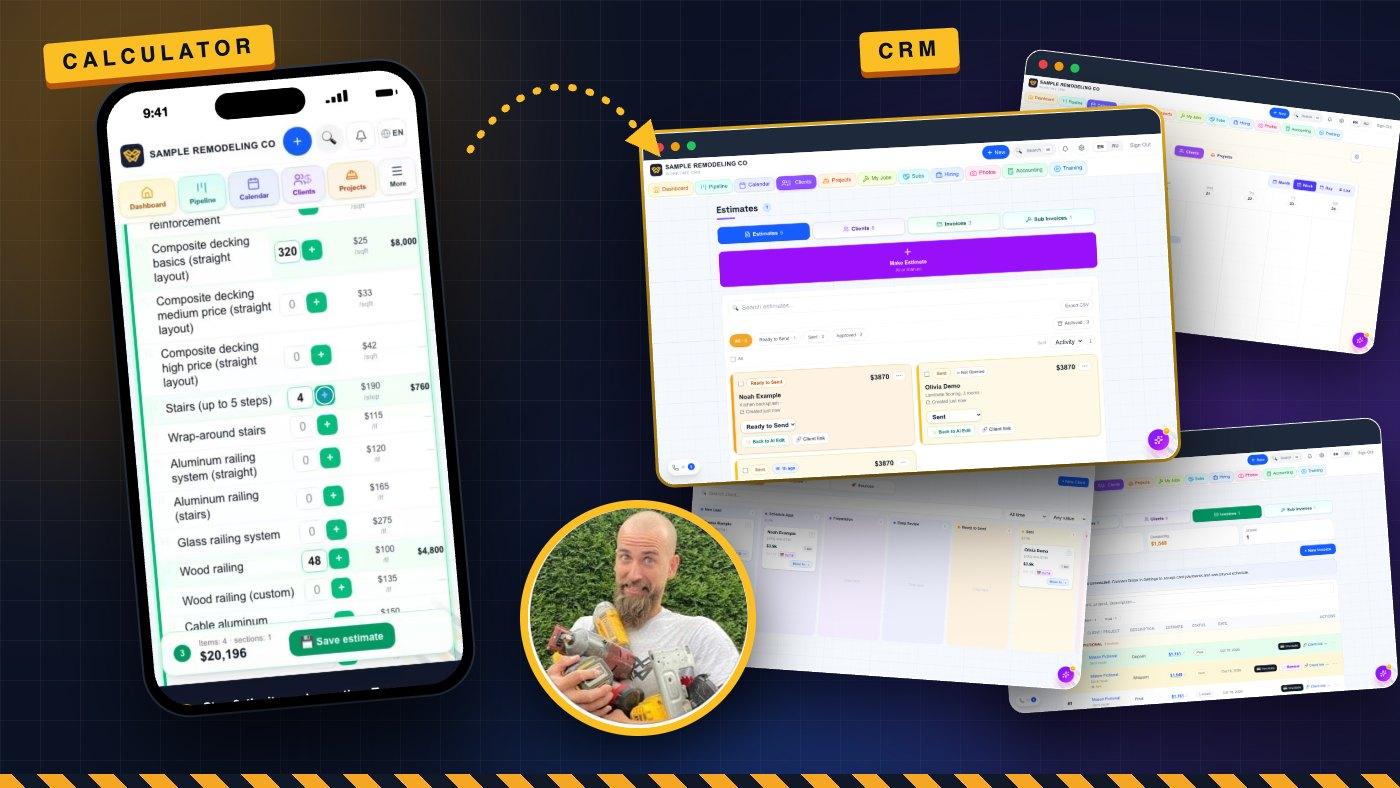
Why I made a calculator
Every lead starts with the same question: "How much for a bathroom?" I answered it all the time, and every time I counted from scratch: demolition, tile, plumbing, materials.
So I put my numbers into a calculator and opened it to everyone. It was a list of jobs, each with its own price. You enter the quantity and see the total at the bottom. No sign-up and no "call us for a quote". I called it the Work Time calculator. The manual calculator in WorkTime CRM works the same way today.
Back then almost nobody around me built apps for this, and AI could not do it yet. I made it the way I make everything: I needed it on the job, so I sat down and figured it out.
My prices walked off, and that was fine
The calculator was open to everyone, and that included other contractors. People I met told me: "I took prices from your calculator. I built my estimates from it."
A builder is supposed to guard his prices. I thought about that too. But a man who took my numbers still has to show up, set the tile straight and answer the phone. The numbers alone do not win him the job.
I like hearing it. It means the calculator helped people, and not only me.
Last summer we looked at the websites of eight remodeling companies in the Seattle area. A calculator with prices on the first screen was on one of them. Ours.
How the calculator became a system
A calculator gives a number. Then the number has to become an estimate with a client's name on it. The estimate has to be sent. Then comes an invoice, a schedule, a crew, photos from the job. Each time I needed the next piece, I added it.
Today it is called WorkTime CRM. It has 16 calculators by trade with 1,223 priced lines, an AI estimator that reads job photos, clients, invoices, projects and a calendar. I did not plan a CRM. I kept solving the next problem in my own company.
Others walked the same road
Later I found out this road is well known.
Basecamp. The authors of the book Getting Real write: "A great way to build software is to start out by solving your own problems." They ran a design firm and needed a simple way to talk with clients about projects. The tool they made for themselves became their main product.
Slack. A company called Tiny Speck was making an online game, Glitch. For the work the team used its own internal chat. The game did not take off, and the chat was released to the public in August 2013.
Chefs. In the book Rework, Jason Fried and David Heinemeier Hansson tell businesses to do what chefs do. A chef has a restaurant and also writes a cookbook with the same recipes he cooks from. He is not afraid, because a recipe is not a restaurant. My open prices are that cookbook.
What I want to say to builders
Keep learning something new. Keep up with the times. I am a builder, and today I can make things that look nothing like construction.
You do not have to be a programmer. Take one thing in your work that eats your time every week and make a tool for it: a table, a form, a calculator. AI will help with what you do not know how to do.
And show it to people. I am glad I did not hide mine. It was not for nothing.



Comments